

Hire Expert Cassandra Developers

Role
cassandra developers
Scale your data infrastructure with Logamic's top-tier Cassandra talent. Our skilled developers design and implement distributed database solutions that handle massive data volumes, ensure high availability, and deliver consistent performance across global deployments, enabling your organization to grow without limits.
Role
cassandra developers
Rated 5/5 stars based on 100+ reviews

Rated 4.9/5 stars based on 11 reviews

Our cassandra engineers

Maria
Cassandra developer
Previously at


René
Cassandra developer
Previously at


László
Cassandra developer
Previously at


Roxana
Cassandra developer
Previously at


Dagmar
Cassandra developer
Previously at


Ján
Cassandra developer
Previously at


Bianca
Cassandra developer
Previously at


Peter
Cassandra developer
Previously at

Are you looking for someone else?


In the past years of cooperation, Logamic was able to help us with sourcing high demand profiles such as Front end, full-stack developer and DevOps Engineer in a nearly instant manner. Logamic was not only able to provide experienced skilled candidates, but carefully selected personalities fitting culturally to the team.

Ľubomír Karlík
Head of AI Transformation, Raiffeisen, Raiffesen Bank

I always appreciated the technical background of Logamic staff because they understood our needs and provided suitable CVs to us in 1 to 3 days. We contracted for our AI and deep learning product QA automated testers, DevOps, Java and Python engineers over the last years of our cooperation.

Francisco De Sousa Webber
CEO, Cortical

Staffing has never been so easy as since using Logamic for our recruitment needs. With the help of their AI bot, they are always able to provide candidate CVs tailored to our requirements and quicker than others. We have hired app. 25 React, C# .NET, Android and iOS developers, QA testers and DevOps engineers over the last years of co-operation.

Nikola Anusev
Director, Telus

Logamic found the right Software developers to do the digital transformation from on-premise into the cloud. I am satisfied with our long-term cooperation because we can progress rapidly.

John-Paul Pazhedath
Head of Digital Workplace, Wienerberger

Logamic guys are leaders in Microsoft technologies and thanks to their passion for Xamarin and .NET it is a pleasure to cooperate with them.

Milan Hrabovský
DX lead, Microsoft

Logamic is since many years a reliable partner in establishing contact with high-grade candidates. We very much appreciate the partnership with logamic, since they truly provide an excellent service – with realistic pricing included!

Thomas Brustbauer
Managing Director, Uniqua
Discover our success stories
At Logamic, we offer JavaScript development expertise that drives innovation and business growth.

April 12, 2026
The CTO’s Guide to IT Sourcing Models
A practical guide for CTOs comparing In-House Hiring, Agencies, and IT Staff Augmentation to help engineering leaders choose the best model for scaling their tech teams efficiently.

April 12, 2026
Speed-to-Deploy: Hire IT Talent in 72 Hours
Discover how deploying senior engineers within 72 hours eliminates recruitment lag, protects sprint velocity, and gives tech leaders a decisive competitive advantage.
April 12, 2026
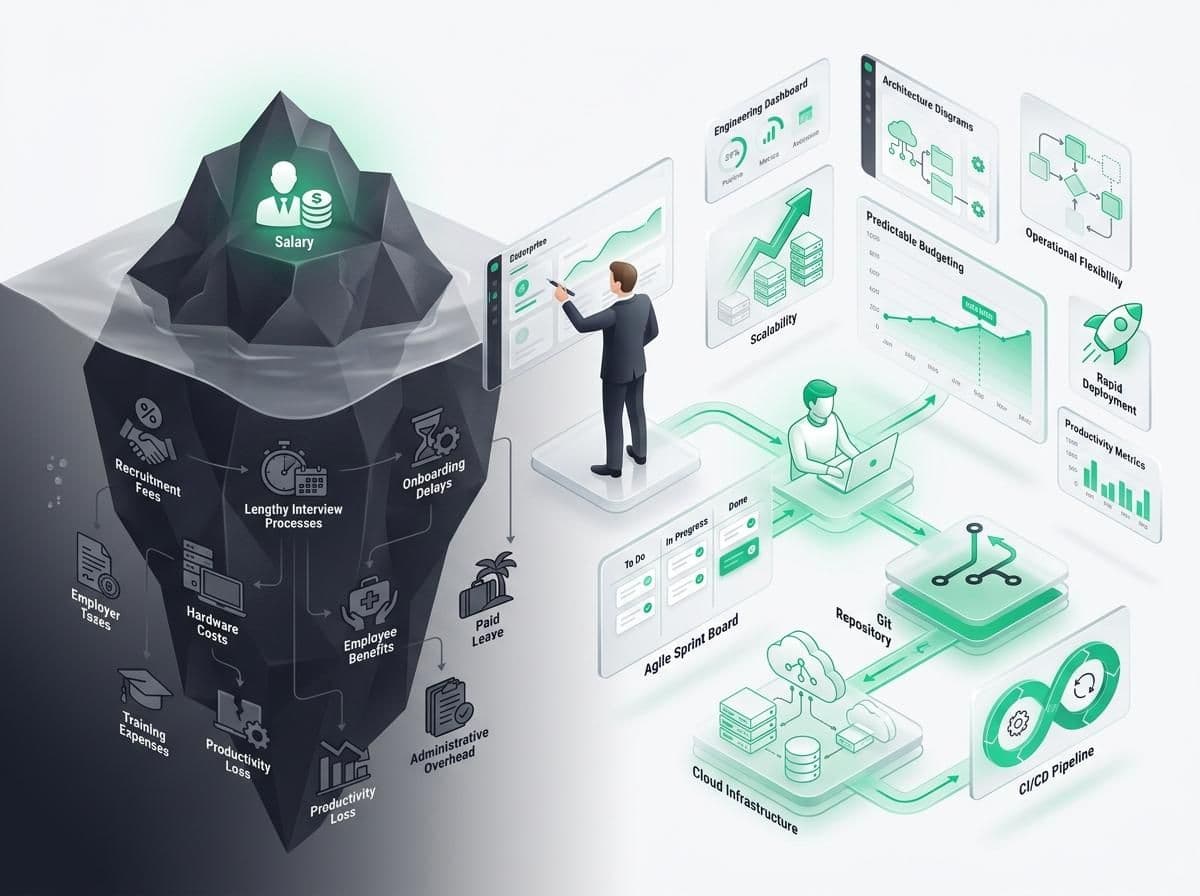
Why Traditional IT Recruitment Is More Expensive Than It Looks
An eye-opening financial breakdown showing CEOs and CFOs why traditional IT recruitment costs far more than base salaries and how staff augmentation eliminates hidden hiring overhead.
Our Hiring Process
A simple, transparent process to help you build your JavaScript development team quickly and efficiently.
Benefits of Hiring Our cassandra Developers
Partner with Logamic to access top cassandra talent and accelerate your development projects.


200 000+ SW engineers
Big database covers your needs.

Fast delivery
Onboard the suitable person in 3 days.

The highest quality
14 years of experience in custom SW development and IT recruiting.

No money ahead
Single payment for all externals after each month.

Perfect match
As ex-developers, we easily understand your technical needs.
Frequently Asked Questions
Get answers to common questions about hiring cassandra developers through Logamic.
How quickly can I hire cassandra developers through Logamic?
Most of our clients are able to hire and onboard cassandra developers within days depending on their internal processes. After you share your requirements, we typically present pre-vetted candidate CVs within 24-48 hours, and you can interview them immediately.
What is the minimum contract period for hiring cassandra developers?
We offer flexible contract options, but our minimum contract period is typically 3 months. This allows both you and the developer to ensure a good fit and successful collaboration.
How do you ensure the quality of your cassandra developers?
All our cassandra developers go through a rigorous vetting process that includes technical assessments, coding challenges, and interviews to ensure they have the skills and experience needed to meet your project requirements. If you prefer to arrange your own coding session, feel free to let us know.
Can I hire full-stack cassandra developers?
Yes, we have a database of full-stack cassandra developers who are proficient in both frontend and backend technologies. You can specify your requirements, and we will match you with candidates that fit your needs.
What if I'm not satisfied with the hired developer?
If you are not satisfied with the hired developer, we work hard to find a replacement at the shortest possible time.
How to Hire Cassandra Developers
A comprehensive guide to finding and engaging skilled Cassandra developers for your distributed database initiatives.
Understanding the Cassandra Ecosystem
Apache Cassandra represents a revolutionary approach to distributed database management, providing a masterless, highly scalable platform that can handle massive amounts of data across multiple datacenters with no single point of failure. Unlike traditional relational databases, Cassandra's architecture embraces eventual consistency and partition tolerance, making it ideal for applications requiring continuous availability and linear scalability across commodity hardware. The Cassandra ecosystem encompasses both technical components and operational paradigms that collectively enable planet-scale data management. At its core, Cassandra provides a distributed architecture based on consistent hashing and virtual nodes, tunable consistency levels that balance availability with data accuracy, a sophisticated replication strategy that ensures data durability, and a column-family data model optimized for write-heavy workloads. This foundation is complemented by the Cassandra Query Language (CQL), which offers SQL-like syntax while respecting Cassandra's distributed nature, and an extensive toolset for monitoring, management, and operation. Beyond the technical architecture, the Cassandra methodology incorporates critical practices like denormalization-first data modeling, which optimizes for query patterns rather than storage efficiency; time-series design patterns that leverage Cassandra's strengths; multi-datacenter deployment strategies for global applications; and operational excellence practices including repair processes, compaction strategies, and backup procedures. These practices are supported by a mature ecosystem of tools like DataStax Enterprise, Apache Spark integration, and various monitoring solutions. The Cassandra approach offers significant advantages including linear scalability that grows with your data, continuous availability with no downtime for maintenance, geographic distribution for compliance and performance, write optimization for high-velocity data, and battle-tested reliability from organizations like Netflix, Apple, and Instagram. These benefits have made Cassandra the database of choice for applications requiring massive scale, global distribution, and 24/7 availability. Understanding this ecosystem is essential when identifying the right Cassandra developers for your organization. Beyond general database knowledge, effective Cassandra professionals must grasp distributed systems principles, appreciate the CAP theorem's implications, understand denormalized data modeling, and know how to design for failure in distributed environments rather than assuming traditional ACID guarantees.

Ready to boost your development capabilities?

Connect with our expert cassandra developers and accelerate your project timeline.